
Forecast and Tricast Betting: Mobile Exacta Returns
 Available in US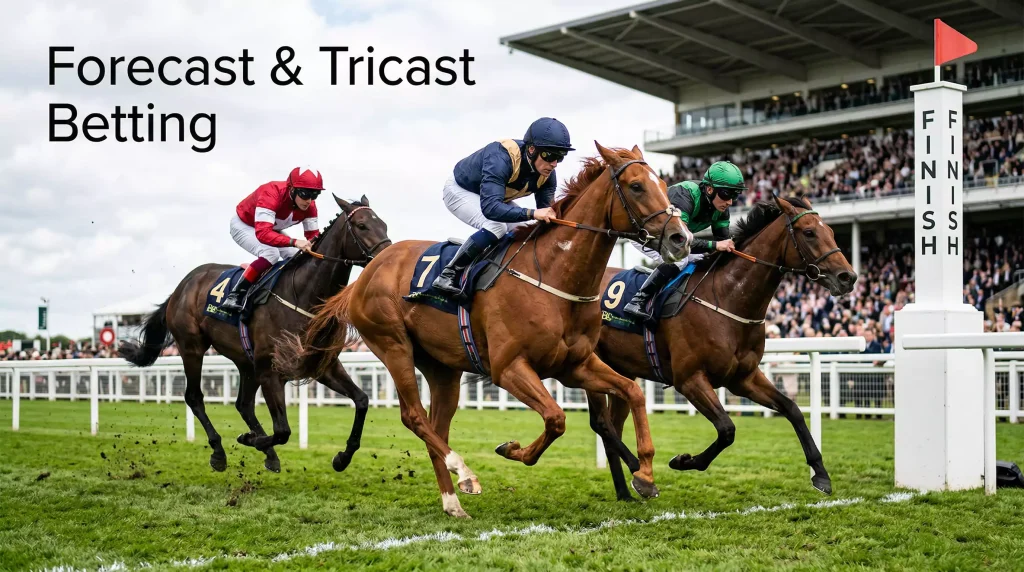
Forecast and Tricast Bets: Calculating Mobile Payouts
Picking winners tests your form analysis. Picking the exact finishing order tests something deeper — the ability to rank multiple horses against each other with precision. Forecast and tricast betting rewards this skill with returns that can dwarf standard win bets. Predict the podium, pocket the payout.
These bet types ask you to identify not just which horses will finish at the front, but in what sequence. A straight forecast requires naming first and second in exact order. A tricast demands first, second, and third, again precisely positioned. The difficulty increases exponentially, but so do potential dividends when your assessment proves correct.
Forecast and tricast markets feature across seven out of ten major UK betting apps, available on all UK and Irish racing. As Grainne Hurst of the Betting and Gaming Council observed: “This demonstrates the growing, long-term investment regulated betting provides British horse racing. But it is concerning to see once more despite record levy contributions, racing continues to struggle, both as a sport and as a betting product.” Within that struggling product, forecast betting represents one area where skilled punters can find genuine value — particularly in races where the market underrates obvious placers or overrates false favourites.
Straight vs Reversed Forecasts
A straight forecast requires two selections to finish first and second in the exact order you specify. You name Horse A to win and Horse B to finish second. If Horse B wins with Horse A second, you lose. The precision demanded justifies the enhanced returns available.
Consider the mechanics. In a 10-runner race, the probability of correctly identifying the winner might be 10 per cent if all were equal. Identifying that same horse to beat a specific rival into second compounds the difficulty. The forecast dividend reflects this improbability — returns can reach 20/1, 50/1, or higher depending on the horses involved and the Computer Straight Forecast calculation.
Reversed forecasts cover both finishing permutations. You select Horse A and Horse B without specifying which finishes first or second. If either order occurs, you win. This doubles your stake (two straight forecasts combined) while halving the precision requirement. The returned dividend applies only to the winning permutation, not both.
The strategic decision between straight and reversed depends on your confidence in finishing order. If you believe Horse A will beat Horse B but would not stake anything on B beating A, a straight forecast concentrates your stake on that specific outcome. If you rate both horses highly but cannot separate them, a reversed forecast captures either result.
Minimum field sizes apply. Most bookmakers require at least three runners for forecast betting, though Computer Straight Forecast dividends typically need larger fields to generate meaningful returns. Small fields with obvious first and second candidates return minimal dividends, making the bet type less attractive in conditions races with few competitive runners.
Mobile apps display forecast options prominently on race cards. Selecting two horses triggers the forecast interface, allowing choice between straight, reversed, and combination variants. The stake input adjusts automatically for reversed forecasts, doubling the displayed unit stake to reflect the two underlying bets.
Combination Forecasts
Combination forecasts extend coverage beyond two horses. Rather than selecting exactly two runners for first and second, you nominate three or more, and the bet covers all possible first-second permutations among them.
A combination forecast with three horses creates six bets: A-B, A-C, B-A, B-C, C-A, C-B. Each represents a straight forecast on that specific pairing and order. Your stake multiplies by six accordingly. If any two of your three selections finish first and second in any order, one of those six bets wins.
Adding a fourth horse to the combination expands coverage to 12 bets (four horses, each able to finish first paired with any of three others finishing second). Five horses create 20 combinations, six horses create 30, and the escalation continues. Stakes grow rapidly, making large combination forecasts expensive relative to potential returns.
The appeal lies in flexibility. If you believe four horses will fight out the finish but cannot confidently rank them, a combination forecast captures any permutation. The trade-off is diluted returns — you pay for coverage of outcomes you may consider unlikely, and the winning dividend applies to just one of many bets placed.
Combination forecasts suit races with tightly-matched runners where form analysis identifies a leading group without clearly separating them. Big-field handicaps, where half a dozen horses hold realistic chances, represent natural candidates. Conditions races with two or three clear standouts rarely justify the combination premium over straight or reversed forecasts on the obvious pair.
Managing stake allocation across combinations requires discipline. A 10-horse combination forecast contains 90 bets — the same unit stake applied to a straight forecast would require £90 total commitment. Adjusting unit stakes downward when using combinations preserves bankroll without sacrificing coverage breadth.
Tricast Betting
Tricasts demand first, second, and third in exact order. The additional selection compounds difficulty further — you must correctly identify not just the winning pair but also the horse completing the frame. Returns scale accordingly, with tricast dividends frequently exceeding anything available from forecasts or standard win bets.
Straight tricasts specify exact positions for all three selections. Horse A first, Horse B second, Horse C third — no other combination pays. This precision requirement makes straight tricasts among the hardest bets to land, but dividend potential on competitive handicaps can reach three figures from modest stakes.
Combination tricasts work identically to combination forecasts but across three positions. Three horses create six permutations (3 × 2 × 1). Four horses create 24 permutations. Five horses create 60. The mathematics escalate rapidly, with stake requirements following suit. A combination tricast covering six horses requires 120 unit stakes — impractical for most recreational punters.
Tricasts require minimum field sizes, typically eight runners or more, depending on the operator and race type. Handicaps meet this threshold routinely; small-field pattern races rarely qualify. Where tricasts are available, they appear alongside forecast options in the app interface.
The skill premium for tricasts exceeds forecasts substantially. Identifying a probable winner requires strong form analysis. Separating likely place horses demands deeper understanding of how runners perform under pressure, their finishing speed, and their relative ability against specific opponents. Punters who excel at ranking multiple horses — not just identifying single winners — find tricasts reward their expertise disproportionately.
Combining tricast selections with sound stake management maximises long-term potential. Small stakes on well-researched combination tricasts can occasionally deliver spectacular returns while limiting downside to affordable losses. Treating tricasts as high-variance entertainment rather than consistent income sources maintains appropriate perspective.
CSF vs Fixed Odds
Computer Straight Forecast dividends represent the standard payout method for forecasts and tricasts in UK racing. Understanding how CSF differs from fixed odds forecasts clarifies what to expect when bets land.
CSF dividends are calculated after the race using a formula based on starting prices and finishing positions. The calculation accounts for how the market priced each horse, adjusting returns to reflect the actual improbability of the outcome. A forecast involving two outsiders generates larger CSF dividends than one pairing the favourite with the second favourite.
Fixed odds forecasts, offered by some bookmakers, lock in your dividend at bet placement. You see exact potential returns before the race, removing CSF uncertainty. The trade-off: fixed odds typically undercut what CSF would pay on the same outcome, as bookmakers build additional margin into guaranteed prices.
Comparing CSF returns against fixed odds offers requires historical awareness. On average, CSF pays slightly better over large samples, but individual races can see fixed odds exceed CSF substantially — particularly when late market moves affect starting prices after you have locked in your fixed return.
The UK Gambling Commission oversees the integrity of dividend calculations, ensuring CSF formulae operate fairly across licensed operators. This regulatory oversight provides confidence that declared dividends reflect genuine mathematical outcomes rather than arbitrary bookmaker decisions.
For most punters, CSF remains the default and most widely available option. Fixed odds forecasts suit those who prefer certainty over potential optimisation. Checking which option applies before confirming forecast bets prevents confusion when dividends are declared and settled.
